
Workplace Noise Limits in the UK: Understanding Real Workplace Exposure
Understanding workplace noise exposure within industrial environments, including UK noise limits, personal dosimetry, hearing protection and practical occupational noise assessment guidance.
By James Hall BEng MSc CertOH LFOH
Workplace Noise
Control of Noise at Work
Workplace Noise Limits in the UK: Understanding Real Workplace Exposure
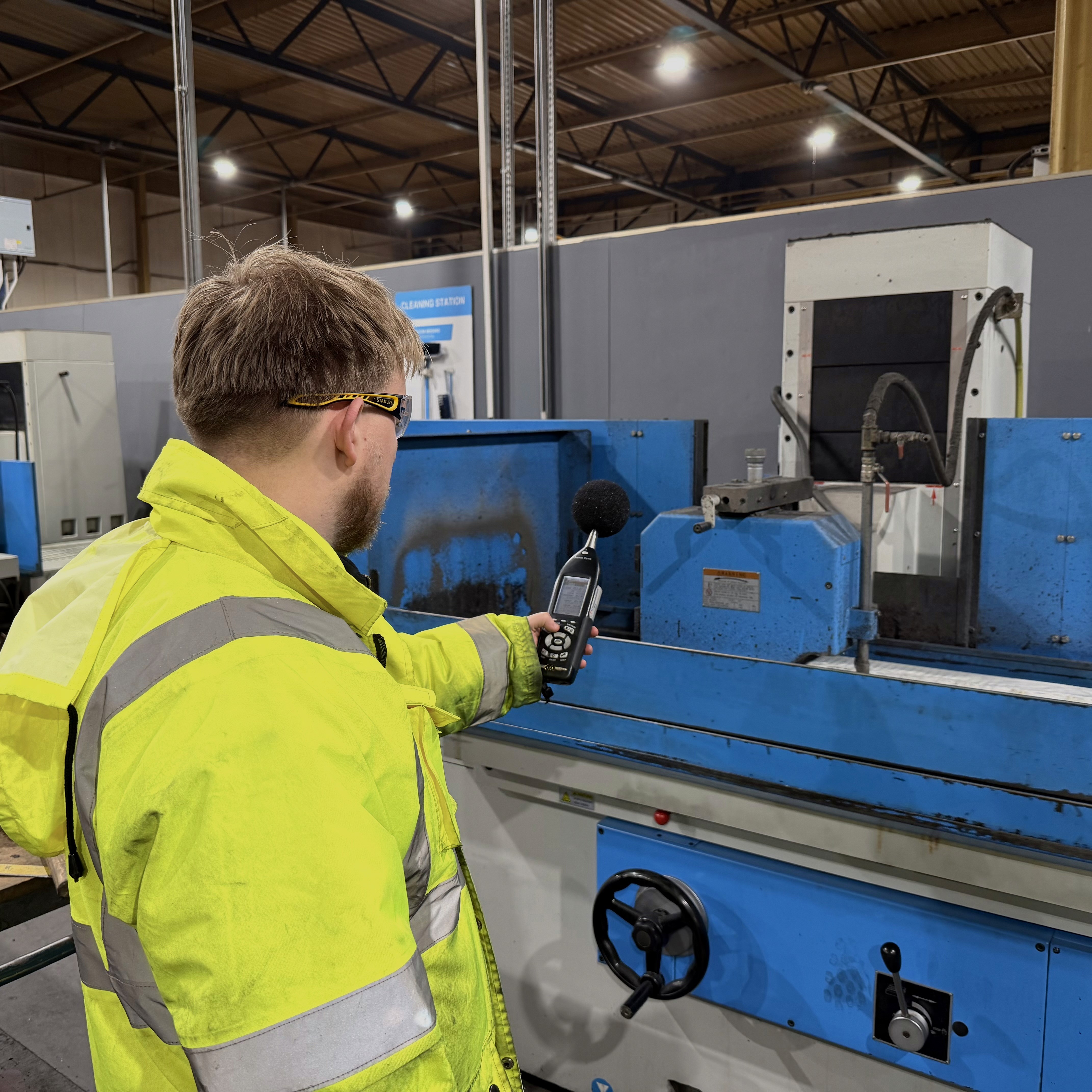
Workplace noise exposure is often associated with obvious high-noise environments such as fabrication workshops, woodworking facilities and heavy engineering operations. In practice, however, occupational noise exposure can vary significantly depending on process, task duration, operational layout, production changes and employee activity throughout the working day.
While the Control of Noise at Work Regulations establish clear exposure action values and legal limits, understanding real employee exposure within operational environments is not always straightforward. Short-duration activities, intermittent tool use and changing operational conditions can all contribute significantly to overall daily exposure.
As such, workplace noise assessments should not simply focus on whether noise is just "loud”, but how employees interact with equipment, environments and operational processes over representative working periods.
Understanding Workplace Noise Exposure Limits
Under the Control of Noise at Work Regulations, employers are required to assess and manage risks associated with occupational noise exposure. The regulations define three key exposure thresholds:
Lower Exposure Action Value: 80 dB(A)
Upper Exposure Action Value: 85 dB(A)
Exposure Limit Value: 87 dB(A)
These values relate to daily or weekly employee noise exposure, taking into account both noise level and duration of exposure. In practice, this means that relatively short periods of high-noise activity may contribute disproportionately to overall employee exposure, particularly where powered tools, compressed air systems, impact equipment or continuous operational machinery are involved.
Why Real Workplace Exposure Is Often Difficult to Estimate
One of the most common issues within industrial environments is assuming that workplace noise exposure can be estimated simply by walking through an area or judging whether an environment “sounds loud” at one point in time.
In reality, exposure often fluctuates considerably throughout the working day, and throughout the year more generally, depending on employee movement, task variation, maintenance activities, general production levels and intermittent operational processes.
For example, an employee working within a generally moderate-noise production environment may still experience elevated daily exposure due to short-duration use of grinders, impact tools or compressed air equipment throughout the shift.
Similarly, maintenance engineers, mobile operators and production personnel frequently move between multiple operational areas, making representative exposure assessment more complex than single spot measurements alone.
This is one of the reasons personal noise dosimetry is often valuable within industrial environments, as it allows exposure to be assessed over representative working periods under normal operational conditions.
Common Sources of Occupational Noise Within Industrial Environments
Occupational noise exposure can arise across a wide range of industrial and operational environments. The most common examples include:
Fabrication and welding activities
CNC machining and engineering workshops
Woodworking and joinery operations
Production and packaging lines
Maintenance workshops
Noise generation may originate from continuous production equipment, extraction systems, compressed air use, powered hand tools, material handling systems, conveyors or intermittent impact activities. In many cases, overall exposure is influenced not only by equipment noise levels, but by duration of exposure, proximity to equipment, operational layout and working practices.
The Role of Personal Noise Dosimetry
Personal noise dosimetry plays an important role within many workplace noise assessments, particularly where exposure patterns vary throughout the working day.
Unlike fixed-area monitoring, dosimetry measures exposure directly at employee level over representative operational periods, providing a more accurate understanding of cumulative daily exposure.
A personal noise dosimeter is typically attached near shoulder or collar level and worn over a representative 4–6 hour period, allowing both average daily exposure levels (LEP,d / LEX,8h) and peak noise events (LCpeak) to be assessed under normal operational conditions.
This methodology is particularly useful within environments where employees:
Move between operational areas
Undertake varied tasks
Work intermittently with powered equipment
Alternate between quieter and higher-noise activities
Representative dosimetry data allows organisations to make more informed decisions regarding hearing protection, engineering controls and long-term exposure management.
Appropriate Hearing Protection & The Risk of Overprotection
Hearing protection forms an important part of workplace noise management within many industrial environments. However, effective hearing protection selection is not simply about choosing the highest possible attenuation.
In some situations, excessive attenuation may create operational difficulties by reducing communication ability, limiting awareness of warning signals or isolating employees from surrounding operational activity.
Overprotection may also contribute to reduced compliance if hearing protection becomes uncomfortable or impractical for day-to-day operational use. As such, hearing protection should be proportionate to the actual exposure risk identified during assessment.
Different forms of hearing protection may be appropriate depending on the working environment, operational requirements and level of exposure. Typical attenuation ranges can vary significantly depending on product type, fit and usage conditions:
Hearing Protection Type | Typical SNR Range |
|---|---|
Disposable foam earplugs | ~28–39 dB |
Reusable earplugs | ~20–32 dB |
Banded/semi-insert plugs | ~15–25 dB |
Standard earmuffs/defenders | ~20–34 dB |
High attenuation earmuffs | ~30–37 dB |
Dual protection (plugs + muffs) | Typically ~5 dB above highest single protection |
Selection should consider not only attenuation performance, but also compatibility with other PPE, comfort, communication requirements and practical operational use.
Using Headphones & Wireless Earbuds as Hearing Protection
During workplace noise assessments, we have increasingly observed employees using consumer headphones and wireless earbuds within operational environments. While these devices may provide some perceived reduction in background noise, they are not typically designed or certified as occupational hearing protection.
For example, standard AirPods or open earbuds will generally offer negligible meaningful attenuation. Attenuation may increase depending on headphone type, such as over-ear active noise cancelling (ANC) headphones or in-ear silicone seal earbuds. However, attenuation performance is highly variable and these devices are not intended to provide reliable protection against occupational noise exposure within industrial environments.
In higher-noise environments, users may also increase listening volume to compete with surrounding noise, potentially contributing to additional exposure rather than reducing it. Noise cancelling technology should not be considered a substitute for appropriate workplace hearing protection assessment and selection.
Workplace Noise Assessments Across Industrial Environments
At NOHH Ltd, we support manufacturing, engineering and operational organisations with workplace noise monitoring, personal dosimetry and exposure assessment services by BOHS-qualified occupational hygienists.
We provide workplace noise services across North East England, Teesside, Leeds & West Yorkshire, Hull & Humber, Cumbria and the Scottish Borders. If you have an upcoming noise assessment or would like to discuss workplace noise exposure, please feel free to get in touch with our noise experts.
CONTACT US